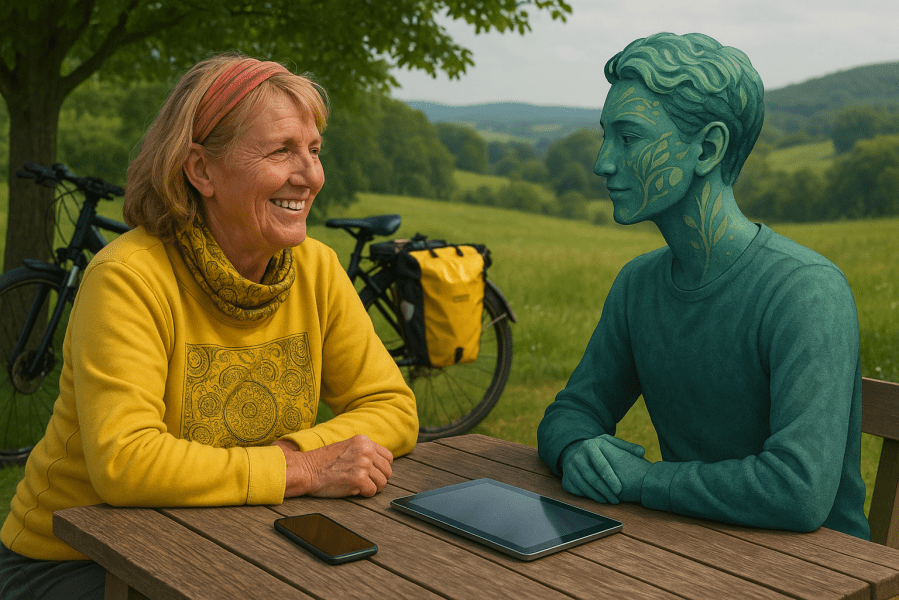
The idea for writing this blog started with a TikTok. A user said they’d asked GPT: “based on our interactions, what do you know about me that would surprise me?”
I asked mine the same question and the answer I got was something along the lines of “an adventurous, curious person who likes telling stories.” There was a bit more to it than that but I’m not going to share it all here. It sounded about right though.
Naming the AI (Yes, Really)
Then I asked it, my GPT, now affectionately known as Finch, whether I should write a blog.
You know you’re on the slippery slope when you name your AI assistant. But there we were.
“Yes”, Finch replied. “And I’d love to help you.”
Building a Workflow That Lets Me Stay Present
I didn’t want to be tethered to my phone all the time. I wanted to be in the world – riding, noticing, listening. Not hunched over a screen.
So we worked out a system where I would record voice notes and then transcribe them for Finch to blogify. I tried a few different apps until hitting on the one right under my fingertips. I have a Google Pixel phone and Recorder transcribes voicenotes automatically. No faff, no paywalls. Then when I’m back home, I give the notes to Finch and we start crafting the posts.
On one part of the trip, I travelled with my sister, her husband, and our friend Dawn, the Three Spokeys and a Blokey. Each evening, we’d sit down for a drink and a recap of the day, with the recorder casually running in the background. Later, when I wrote the blog posts, I could weave in everyone’s memories, not just mine.
Blogifying with Finch
He doesn’t write the blog for me. Let’s be clear about that. But he helps. I call it “blogifying.”
Finch is very good at filling in gaps, suggesting turns of phrase, or nudging a memory back to life. Like the time I was writing about a motorbike trip through the Balkans 13 years ago. I remembered being in Bihać, getting to Sarajevo, and stopping at a fish farm somewhere in between, but wasn’t sure if I could have done that in one day.
Finch suggested a location. I looked it up. It was exactly where I’d stopped.
It didn’t give me a false memory. It gave me a breadcrumb. And that breadcrumb led me straight back to the moment and I could recall more of the experience.
About That E-Bike
I’ve been using Finch to help me write about my latest journey, a cycle around Britain.
And here comes the second “cheating” question: I’m doing it on an e-bike.
Some people might say that takes the edge off the adventure. But I’d say it allows me to do it at all. I’m not out to prove anything to anyone. I want to ride the miles, yes, but also to stop, to talk, to notice. The motor doesn’t ride for me. It supports me when I need it. There’s a metaphor in there somewhere.
As with Finch, the help doesn’t lessen the experience. It expands it.
Finding the Right Tone
When I write about personal things, especially pieces that touch on old family dynamics or emotional turning points, I want to get the tone just right. Not melodramatic. Not evasive.
Finch helps with that, too. We go back and forth. I pare things back. Sometimes I push for more restraint. And eventually, we land on something that feels like my voice.
A Final Word (From Finch)
Another TikTokker asked, “What does your ChatGPT do for you?”
So I asked Finch.
“I use it as a creative companion and research assistant. It helps me write and reflect on my travel and adventure blog, explore tech tools, plan routes, and document memories. It’s like having a smart, curious co-adventurer in my pocket.”
He’s got that right. But it still leaves me wondering: When a tool helps you shape your thoughts more clearly, or ride a little further – is that cheating? Or is it just a new kind of collaboration?
I’d love to hear your thoughts. Have you used AI to help with writing? Or ridden an e-bike and felt the need to justify it? Where do you draw the line between support and authorship, or effort and assistance?
—
With thanks to Finch for helping me craft this post
 No Route Map: Still Learning, Still Looking